Showing posts with label Director: Stanley Kubrick. Show all posts

Saturday, September 18, 2010

52 Perfect Movies: 2001: A Space Odyssey (1968)

"Just what do you think you're doing, Dave?"

To a certain extent, this can be said of virtually every film included in this, the 52 Perfect Movies series--but it is especially true of Stanley Kubrick's 2001: A Space Odyssey: It almost requires no explanation at all for this film to be included here. 2001 is a work of pure, undistilled genius; a breathtaking piece of art put forth into this world by the combined intellects of Kubrick and the legendary Arthur C. Clarke, to be savored, pondered and debated for all time to come.

As science fiction epics go, it is the gold standard--an intoxicating, cerebral journey into the issues that resonate most deeply with the human race as a species, and with the human being as individual. There are no laser guns required, no Flash Gordon-esque childish gimmickry on display. This is science fiction for grown-ups, that speaks to us on a mature level, in our own time and place, rather than a long time ago in a galaxy far, far away.

Kubrick famously rebuked those who tried to get him to explain the much-discussed finale to the film, insisting that they had to figure it out for themselves. Perhaps he was being clever, or perhaps he actually didn't quite know himself, but I will forgive him this bit of obtuseness. Whatever it may actually mean--and I have several theories, but this is not the place for them--it is quite true that it exists on another level, beyond the intentions of Kubrick or Clarke. It, like the rest of this monumental film, is there for the viewer to experience, to digest, to absorb and make of it what he will. Art at this level owes us no easy explanation.

Taking a genre of film that had long been the province of Saturday afternoon serial matinees or chintzy post-war monster movie fare, and elevating it to a place of beauty and depth of thought and feeling rarely seen in film, 2001 is the definition of a cinematic landmark. And even if the science fiction genre never quite lived up to the promise of this film, that does not take away from its achievement.

We see Kubrick here cementing his other-wordly, sterile, appropriately alien directorial style, approaching the material with the precision of a surgeon and the uncanny depth of perception we might actually expect from an observant alien race. The man was a gift to the craft of film-making, and it's entirely possible that this fact was never so completely established as in this motion picture, a model of perfection in editing, cinematography and sound design, among many other things.

As in much of Kubrick's work, it is the bigger picture here that takes us in and holds us. Kubrick was a stylized film-maker, no doubt about it, and here he sets a pace that certainly takes its time, paradoxically whizzing across various distant epochs in time, and millions of miles of space, and yet always moving at an even keel, fascinating us with the way the story is carefully unfolded, the characters patiently revealed to us. To those weened on music video editing styles, a film like this may seem a chore indeed, and that is quite sad. Because although it moves at anything but a brisk pace, this is the kind of film that must be slowly and deliberately savored, and rewards those who do.

From the masterful scenes at the "Dawn of Man", featuring tribes of primitive ape-men so convincing that suspension of disbelief is a non-issue, to the clean, bright, deceptively calm moments during the Jupiter mission, A Space Odyssey is an unstoppable juggernaut of a movie, cruising majestically along, metaphorically towering above the viewer like the implacable monolith itself. Here at the start of what many refer to as the "modern era" of movie-making, Kubrick shows us how it's done, setting the bar extremely high--perhaps too high, really--for any who woud dare to come after him, and taking the very practice of film-making to places previously undreamt of.

Keir Dullea and Gary Lockwood are terrific as Dr. Bowman and Dr. Poole, the passengers on board the Discovery. And yet, the performance best remembered is that of Douglas Rain as the voice of the computer HAL-9000, whose tragic malfunction and spiral into madness is at the heart of what this movie is all about. Among Kubrick's fascinations was the conflict of the human against that which seeks to dehumanize or automate humanity, and nowhere in his body of work (although Full Metal Jacket comes close) is this theme so directly explored.

The concept of the foolproof, beautifully choreographed scenario slowly sent completely off-kilter into utter choas--this is another favorite idea of Kubrick's, and it's no wonder he took so thoroughly to Clarke's material, as it speaks to this concern of his quite directly. Clarke himself often said that with 2001, he wanted to raise more questions than he answered. Most devotees of the film (and actually, probably most of its detractors) would agree that he succeeded in doing just that.

The strains of Strauss' Also Spracht Zarathustra, famously used to such powerful effect in this film, almost serve to act as something of a clarion call, waking the movie-going public up to the notion that the era of the auteur film-maker had arrived; that directorial visionaries would, more than ever before, be able to create deeply personal works that directly expressed their souls, with far less outside intervention than the studio system had ever allowed. And to a lesser degree, among those who devoted themselves to genre entertainment, it demonstrated that speculative fiction in cinema could do the very same thing it had been doing for decades in literature.

When discussing greatness in film-making, from a technical point of view, 2001: A Space Odyssey is a film that will invariable be brought up, and rightfully so. It is a sumptuous delight to watch and to listen to, with its groundbreaking (and actually realistic) special effects and brilliant use of classical music, and yet it is also much more than that. It is a film that becomes more than a film. It is an experience. It is a journey, into the self, into that which is beyond ourselves. In short, it is the kind of a narrative work that comes along once in a lifetime.

NEXT UP: The Odd Couple (1968)

Wednesday, July 21, 2010

52 Perfect Movies: Dr. Strangelove (1964)

"Gentlemen, you can't fight in here--this is the war room!"

It is rare to find a director with as awe-inspiring a body of work as Stanley Kubrick. Certainly, part of his highly successful "batting average" is due to the relatively small number of films he made--but much more so, it's due to his sheer genius, and the rare manner in which he voraciously and uncompromisingly brought his visions to life on the screen. There are a few Kubrick pictures which will be popping up during this series of 52 Perfect Movies--the first of them is his sublime political and social satire, Dr. Strangelove.

Kubrick would become known as a film-maker of gravity and intense seriousness, and yet here we have him delving into comedy, albeit comedy as black as coal, much like his previous effort of two years earlier, an adaptation of Nabakov's Lolita. And so we are left with a comedy as only the mind of Kubrick could've given us, wickedly funny, yet unrelentingly bleak; a "message film" concerned deeply with the fate of the world itself, yet also with the foibles of human nature, that manages to remain the complete opposite of preachy or self-righteous.

There really is no other film like Dr. Strangelove. Impossible to completely categorize, it is at times an all-out comedy--or more appropriately, a satire--which for much of the picture, doesn't "feel" like a comedy. With the exception of the appearance of the good doctor himself at the end--an example of Peter Sellers' brilliant physical comedy--much of the humor is slyly cloaked, and can even partly go over the head of some, shall we say, less astute filmgoers.

There's also the fact that it doesn't look like a comedy. Like most of Kubrick's work, it's heavy and ponderous looking, shot with stark shadows and sterile, almost dehumanizing production design. No one since Orson Welles knew how to use a camera as brilliantly to his advantage as Kubrick did, although in this particular case much of the credit goes to cinematographer Gilbert Taylor, the Englishman who would later work on such masterfully shot films as A Hard Day's Night, Repulsion, The Omen, and a little 1977 popcorn flick known as Star Wars.

In a lot of ways, Dr. Strangelove shows Kubrick really coming into what would be perceived as his "later" phase, in which his films are concerned with nothing so much as the alienation of the human soul, and the slow-burning anxiety of a seemingly perfectly balanced situation sent hopelessly and inevitably off-kilter. This was during the heart of the Cold War, when, despite how things turned out, many did earnestly believe that the world lay constantly on the brink of annihilation, and perhaps this was so. There's a real concern with this matter in Dr. Strangelove, underneath all that ludicrousness. As wry as the presentation is, and as bone dry the comedy is, the heart of this picture is quite serious.

Kubrick's flair for unforgettable imagery and jarring juxtaposition is here in full force. The sexualized mid-air refueling scene that opens the film, accompanied by romantic strings. The maniacal visage of Sterling Haydn's Gen. Jack Ripper, phallic cigar clenched in his teeth. Slim Pickens' iconic ride on the nuclear warhead. The closing moments of atomic Armageddon, set sardonically to the strains of the traditional wartime anthem "We'll Meet Again" by Vera Lynn. No one will ever meet again, because the world is coming to an end--that closing tune mocks the manner in which the Western world clung to outdated concepts of warfare in a time when those rules no longer applied.

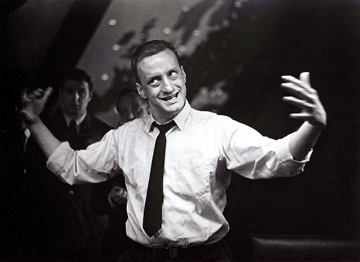
And yet just as much as Dr. Strangelove is a triumph from a technical point of view, it is one of those films that is also just as much of a triumph thanks to the stellar performances of its lead actors. George C. Scott is a revelation as the war-mongering Gen. Buck Turgidson (one of the greatest character names in movie history), a role that put the gruff actor's abilities to exquisite use. Haydn takes us to the depths of madness while at the same time never undermining the ridiculousness of the proceedings, painting the portrait of a deranged, potentially genocidal lunatic who would wipe out civilization to quell the paranoia and doubt raised by his impotence as a man and as a leader.

Then of course, we have Peter Sellers. One of the greatest comic geniuses of the 20th century in what may be, when all is said and done, the most impressive cinematic turn of his career. He was rightfully nominated for an Oscar for playing three different roles, giving him the interesting distinction of being the only actor so nominated for a movie in which he played more than one character.

As Group Capt. Lionel Mandrake, Sellers sends up British propriety and comments on the strained behind-the-scenes alliance of the U.S. and the U.K. in the face of a common enemy. As President Merkin Muffley, he is the epitome of the stifled, emotionally deadened American, a man whose ineptitude becomes both situation comedy and horrifying cultural commentary. And finally, as Strangelove himself, Sellers unabashedly displays his comedy chops as a crippled ex-Nazi desperately fighting to suppress his sheer ecstasy as the world collapses into chaos.

Any one of these parts would have made him the highlight of the picture. With all three, the movie is utterly and wholly his, and it's easy to see why he was a Kubrick favorite. It doesn't make sense somehow that Kubrick and Sellers would be such a perfect match, but it's undeniable that they were.

The razor sharp wit of Dr. Strangelove is rooted in a specific time and place in American history, and yet it's still paradoxically timeless as well. There are moments that resonate just as profoundly as they did 45 years ago, such as Turgidson's outrageous and often-mimicked tirade in the war room, Ripper's deluded rant to a terrified and helpless Mandrake about "precious bodily fluids", or Merkin's panicked, creepily childish yet at the same hilarious phone call to the Soviet premier.

Dr. Strangelove is a bold statement that cinema was changing and that the things film-makers could say--and the ways in which they could say them--was changing as well. To watch it is to watch a true visionary coming into his own, and proving that sometimes there actually can be something new under the sun. There are few experiences for a moviegoer as unique as this film, a complex, dark and endlessly amusing statement on the insanity of the world and its inhabitants that seems to tell us, "If you can't laugh at all of it, what else can you do?"

NEXT UP: The Good, the Bad and the Ugly (1967)