Showing posts with label Director: David Cronenberg. Show all posts

Wednesday, January 19, 2011

Friday Night Films: Naked Lunch (1991)


For some reason as of yet unknown, I decided recently that it would be a good idea to read William S. Burroughs' Naked Lunch. I had previously read all about Cronenberg's adaption in Cronenberg on Cronenberg and was instantly drawn to it. Clearly I was enticed by a book that could possibly feature a drug addict's stream of consciousness and giant bugs. Well let me tell you something. If anyone tells you that it's a good idea to read Naked Lunch--kick them. Naked Lunch may in fact be the craziest thing you will ever try to read. Nothing makes sense, nothing is linear, and it's barely readable. If you don't know already, this is the book William S. Burroughs wrote while he was in a state of constant high thanks to some crazy Moroccan drugs. Yeah.

After about 30 pages I gave up and moved onto Cronenberg's take on the story. Cronenberg's film is actually less of an adaption of the book and more of an interpretation. He used real incidents from Burrough's life, kept some of the same names and places and the film became the story of how Burrough's came to write Naked Lunch.

Now, I want to make it very clear that I know Cronenberg. I'm used to his style, and his constant need to include something that resembles a penis in anyway that he can.
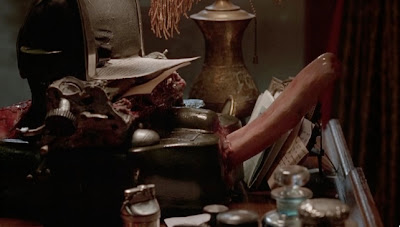

I'm used to his themes of blending the physical with the psychological, and how he often intertwines the two as though they were one. I'm used to the overtly gooey style of blood and guts and I'm used to how amazing yet utterly mind numbing and weird his films can be. That being said, Cronenberg's Naked Lunch is the strangest movie I have ever seen.


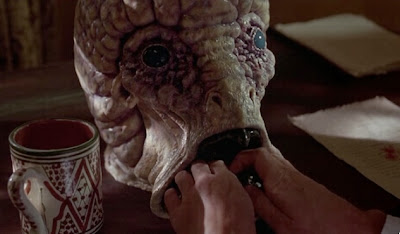
Watching Naked Lunch is basically a film that you just have to watch. By that I mean, you really can't think too much while you're watching it or you'll get incredibly frustrated. Don't try to make sense of why typewriters are suddenly changing into giant beetles.


Don't try to come up with a sane approach as to why the type writer bugs have ginormous penis' and definitely do not try to make any big conclusions about drug use and its effects on the writer. Just relax, and take it all in on a visual level. Worry about the deep meanings later....MAYBE.
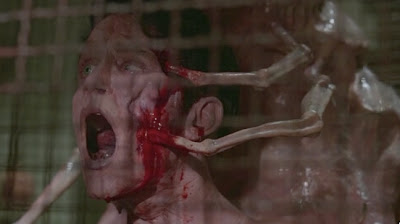


Here's the thing about Naked Lunch---I have no idea what the hell it means and I don't really plan on ever finding out. I would rather just sit and marvel at how completely outrageous the whole thing is. Naked Lunch is one of those films that oddly knocks you back into reality. It reminds you that you are NOT as smart as you think, and that no matter how hard you try--you will never be able to make a film quite like this. That's what always throws me off about Cronenberg. He isn't one of those directors that make seemingly genius films yet refuse to tell anybody what they really mean (cough David Lynch). Cronenberg however knows exactly what his films mean and he explains it and this is the best part---it makes sense!
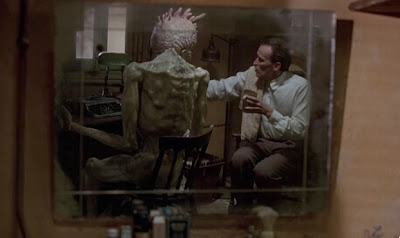


To be honest, I'm not at all interested in what the true meaning of Naked Lunch is. I'm much more interested in seeing the way that David Cronenberg processed the book into a logical movie (well, logical as in it does have somewhat of a plot). I can't even fathom taking a book like Naked Lunch and converting it into a readable screenplay. And then to see what he did with it---how he took real elements from Burrough's life and somehow involved all these giants insects and penis' and men hiding in woman's skin--
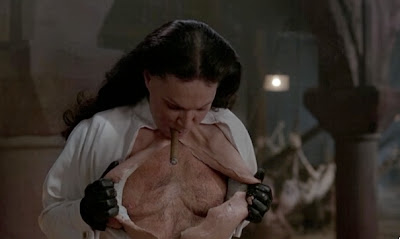


it's kind of mind blowing. As if the very concept and idea of Naked Lunch wasn't mind blowing enough...David had to once again blow us away with his creativity and intelligence.

So what if we may never know what it means? What's so wrong about just watching a film and not trying to dissect it? If there was ever a movie that stood for "Not giving a fuck"--Naked Lunch would be it. Yes, it's probably the weirdest thing that Cronenberg has ever done and yes it's insane but good god, I think I love it--and that's all I really care about.

Tuesday, July 13, 2010

The Great Unwatched: Bava, Argento, Cronenberg

There are two goals to my Great Unwatched project. The first is to see some films that I might not otherwise give the time of day to. The second is to finally experience movies I should've watched a long, long time ago. This weekend, I focused especially on the latter goal, filling in gaps in the filmographies of three of my favorite horror directors: Mario Bava, Dario Argento, and David Cronenberg. I even made a special effort to watch some of their non-horror offerings mixed in with the usual fright flicks.

Film 1: Hercules in the Haunted World (1961, Mario Bava)
Bava's second (credited) turn as director is a fascinating tale of swords 'n' sandals with a bit of Christopher Lee thrown into the mix. Hercules (Reg Park) journeys to Hades to retrieve a mystical stone that will save the life of his lady love, Princess Deianira. What our musclebound hero doesn't know is that his girlfriend's wicked uncle (Lee) is machinating to use Deianira's blood in a ritual to make him immortal. Hercules in the Haunted World was Bava's first opportunity to show what he could do with color and he really wows. The scenes of hell in particular show his visual mastery. Reportedly Bava used a few movable walls and a handful of columns to form every interior set in this film, resorting to visual trickery when he needed it to look like he had more. He creates an expressionistic peplum film, which works best when taken as a visual feast hung on a loose plot.


Film 2: Erik the Conqueror (1961, Mario Bava) 
An unofficial remake of Richard Fleischer's The Vikings (1958), Erik the Conqueror (also known as The Invaders) tells the tale of two Viking brothers, separated as children when their village on the coast of England is pillaged by the vicious Sir Rutford (Andrea Checci). Eron (Cameron Mitchell) is raised by his Nordic brethren. Erik (George Ardisson) is adopted by the Queen Alice of Scotland (or Britain, depending on whether you're watching the movie dubbed or subtitled) and grows up to become the Duke of Helford.


What struck me about Erik the Conqueror was the care taken that neither Viking or English were portrayed as villainous or unsympathetic. Both sides are caught in the cycle of violence known as history, occasionally manipulated by Sir Rutford to achieve his own ends. Certainly the Vikings are portrayed as more brutish and violently-inclined, but they're also largely honorable, honest people. The English are more cultured, but they are given to subterfuge and, in the case of Sir Rutford, outright treachery. 

The best sequences, visually, take place in the Viking's headquarters, a large cave where Bava's colored gels run wild. The centerpiece of the set is the giant gnarled tree from Hercules in the Haunted World, which looks magnificent in this new context.

Overall, however, the film isn't that interesting, unless you're really into vikings.

Film 3: Fast Company (1979, David Cronenberg)
It's certainly possible to read a lot of Cronenberg's prevalent themes into Fast Company, most notably the intersection of man and technology and the betrayals of corporate America. However, I think it misses the point to a certain extent. This is Cronenberg working in established drive-in fodder territory for the first and only time in his career. He sticks pretty cleanly to the rules by providing a story with clear heroes and villains, plus the requisite amounts of sex and action. William Smith plays Lonnie "Lucky Man" Johnson, a race car driver in his twilight, doing the drag race circuit under the sponsorship of FastCo Oil. When FastCo betrays him (through their corporate liaison Phil Adamson, played by John Saxon), he strikes out on his own. Adamson uses every trick in his book to make sure Lonnie's cars never reach the finish line. Fast Company is slow-moving (ironically) and takes forever to get around to its central conflict. Cronenberg really only breaks out of the mold during a surprisingly brutal climax that kills off two characters and seriously injures a third.

Film 4: Inferno (1980, Dario Argento)
I still don't know what I feel about this one. Certainly it's the most beautiful Argento film I've ever seen. However, the plot is a huge wad of happenstance, with very little rhyme or reason. In some places it seems to want to emulate the structure of its predecessor, Suspiria, but it lacks a character like Susie Banyon for us to relate to. I'll admit that I was already starting to get a little burned out at this point in my marathon, so I might not have given Inferno the due it deserves. Next time I watch, I'll do it properly -- well-rested, with all the lights out, and the soundtrack up loud. Until then, I can't really give a strong opinion one way or the other.

As a bonus to my general theme, however, Mario Bava did some uncredited effects work for the New York segments of the film.

Film 5: Rabid (1977, David Cronenberg)
Rabid is much more in line with Cronenberg's general oeuvre. Marilyn Chambers emerges from experimental surgery with a retractable phallus in her armpit and a craving for blood. Those who she feeds from become blood-crazed zombies. Cronenberg expands on the themes he first posited in Shivers, with disease as a catalyst for societal breakdown. Moving outside the confines of a single apartment building into the city of Montreal, Cronenberg is able to analyze government and public responses to an outbreak of irrationality. Meanwhile, on a parallel track, Chambers is just trying to survive, oblivious to the effect her feeding has on her victims (and her victims' victims). Unfortunately, Cronenberg never manages to blend the external outbreak narrative with the internal vampire one, so the film gets narratively and thematically confused at times. Cronenberg would do better in later films by keeping his focus on a single character navigating through the chaos, as in Videodrome.

Film 6: Phenomena (1985, Dario Argento)
Not a lot to say about this one, except that it was the last film of the night and it didn't do much to grab hold of my already shaky attention. As a sidenote, at some point I may write an article tracking Argento's treatment of Daria Nicolodi's characters throughout their collaborations, as it does seem he gets more brutal with her after they broke off their romantic relationship.

My original plan, incidentally, had been to watch Four Flies on Grey Velvet, but my bootleg (purchased before Mya Communication announced their official DVD) was nearly unwatchable. Very disappointing.