Showing posts with label Decade: 1960s. Show all posts

Thursday, March 3, 2011

52 Perfect Movies: Once Upon a Time in the West (1969)

"How can you trust a man who wears both a belt and suspenders? The man can't even trust his own pants..."

Upon first viewing Sergio Leone's masterpiece, The Good, the Bad and the Ugly, I couldn't help but think to myself, "This is the epitome of the western. It can get no better than this." Leone's unique, European-tinted vision of the American West was so fascinatingly realized that I couldn't imagine it ever being surpassed. And it is perhaps the greatest testament to Leone's genius that he did actually surpass it--although that may be open to argument.

For as sublime and transcendent as The Good, the Bad and the Ugly is, I am now of the opinion that Leone actually outdid himself just a couple of years later with that magnum opus of the spaghetti western, Once Upon a Time in the West. For whatever reason, it gets a lot less attention than its predecessor (perhaps owing to the lack of Clint Eastwood), and it deserves a lot more recognition. TGTBATU may be quite the tough act to follow, but it is my opinion that Once Upon a Time in the West not only follows it with style, but actually overshadows it in terms of quality.

Ennio Morricone's score is just as iconic, if not more so, washing over the film and commanding the viewer's attention. It literally merges with the narrative in a way that happens in very few films. Whether it's Frank's jaw-dropping theme of villainy, the happy-go-lucky Cheyenne motif, or the unforgettable Harmonica riff, this is movie music at its finest. It may not have produced the big hit that TGTBATU main theme became, but no matter. This is music worth listening to and savoring, even without the accompanying images.

Joined with the images, we get a visual feast realized in a way few films ever are. Leone's brilliant cinematographer, Tonino Delli Colli, who had previously outdone himself on TGTBATU, once again triumphs, with spellbinding shot after spellbinding shot. For those who thought John Ford was the high watermark of the Western, this is material to give one pause and force a reconsideration. So many of these shots have been mimiced so many times by inferior filmmakers that it's easy for their power to be lost. But this is the kind of movie that requires viewer sto strip all preconceived notions and thoroughly immerse themselves in the experience.

Charles Bronson is no Eastwood, but the majesty and quiet, almost native nobility he brings to the role of Harmonica thoroughly grounds the film. He is truly a classic Western hero, and one only wonders what would have happened if Clint had actually accepted the role, as Leone wanted him to. I happen to believe, that as great as Eastwood was, Once Upon a Time in the West benefits from the new blood. Eastwood's Man With No Name had run its course.

Then we have Henry Fonda, whom Leone specifically chose in order to achieve the jarring juxtaposition of having one of cinema's most beloved figures playing a deeply evil, despicable character. In an interview once, Leone stated clearly that when Fonda's blue-eyed visage first appears on screen, staring down a little boy he's about to murder, he wanted his audience to mutter to themselves, "Holy shit! That's Henry Fonda!" And that was indeed my reaction, having been so trained to believe in the pathos of Fonda's screen presence. Nevertheless, he manages to turn Frank into one of the most enjoyable screen baddies of all time.

Jason Robards excels as the very memorable Cheyenne, an amoral outlaw with a heart of gold who gets caught in the middle of the epic conflict. The gorgeous Claudia Cardinale is far more than just eye candy, once again adding a unique Mediterranean flavor to one of the Western's most tried and true tropes, that of the beautiful widow with a coveted inheritance. Together, the film's four leads form an ensemble which, for my money, is more effective than that of any Leone western.

To watch Once Upon a Time in the West is to experience all that the cinematic medium is capable of, in pure, distilled form. The script, spare as always in dialogue, nevertheless crackles along with kinetic energy, and boasts one of the single most gripping opening scenes in movie history--with barely a single word uttered. This is the kind of scene that film students should be required to watch in order to understand the power that can be achieved without having to rely primarily on language. Leone and his collaborators understand that they are working in the genre of another country and language, and so choose--very effectively--to work visually, first and foremost. And we get to enjoy the fruits of that effort, which is one of the great pleasures of film.

It's almost as if Leone had learned so much about making Westerns via his previous trilogy, which began with A Fistful of Dollars and For a Few Dollars More, that he felt the need to put all of those lessons to their best use by making one massive, stand-alone film that would synthesize everything good about the previous three, and take it to whole other level of greatness. And that is what he does, transforming the American West into a mythic place beyond any historical reality.

There are those who will always prefer The Good, The Bad and the Ugly to Once Upon a Time in the West. The former is certainly the more well-known. But I will contend that most who have actually seen and digested both of those films will side with me that the later, more underrated of the two is actually superior. I invite those who may not have seen Once Upon a Time in the West to give it a chance and decide for themselves.

The Western is, in many ways, the ultimate expression of American moviemaking, and it's quite ironic that it's greatest examples have come not from America itself, but from Italy. With an objective eye that came not from within the nation itself, but rather from an entirely different milieu, Sergio Leone was able to elevate the Western into something previously unimaginable. It's very fitting that the film's title seems like something out of a fairy tale--for Once Upon a Time in the West is more than just a period film. It is quite literally history transformed into legend. It is majestic; it is archetypal; it is absolutely glorious.

NEXT UP: The Godfather (1972)

Friday, October 29, 2010

52 Perfect Movies: The Odd Couple (1968)

"Now it's garbage."

Interestingly enough, when one mentions The Odd Couple, the first thing that comes to the mind of most people is the admittedly amusing 1970s television series starring Jack Klugman and Tony Randall. And while this is not meant as a swipe against that show, it is a shame that it gets more attention than the original play by Neil Simon, which inspired this absolutely classic late 1960s motion picture comedy, featuring one of the finest comedy teams to ever appear on screen.

Simply put, The Odd Couple is Neil Simon's funniest and most brilliantly written play. And that's saying quite a bit when talking about one of the greatest humorists and playwrights of the 20th century. Simon is somewhat underrated, as comedy tends to be overshadowed by drama, particularly on the stage. But make no mistake about it, The Odd Couple is a fine piece of writing, filled with witty lines, unforgettable characters and absolutely iconic scenes. It is the kind of comedy that approaches perfection, and that's why it makes this list.

Whoever first thought of putting Walter Matthau and Jack Lemmon on screen together deserves some kind of award. Coming along as they did, a bit after the golden age of movie comedy teams, they don't always get the credit they deserve. But they brought a unique chemistry whenever they were together, and it's no wonder they did appear in so many films alongside each other. However, this one if the epitome of them all.

Lemmon's Felix Ungar and Matthau's Oscar Madison are so fully realized and play off each other so well, and it's truly a pleasure to behold as they interact with each other. Matthau and Lemmon really brought out the best in each other, not to mention struck the perfect balance of combativeness and actual warm friendship. In spite of all their issues, we know that Oscar and Felix are true friends, and this is as much due to the performances as it is to Simon's writing.

What's also interesting about this film is that it does not quite give us the happy, pat ending we expect from a film like this. Rather, it challenges us, ending on a note that rings truer with regards to the actual nature of friendship and human relationships than what we might expect given the light-hearted nature of the material. It's in moments like these that it's easy to grasp the vast difference in quality between a film like this, and the safer, more broadly comical TV series it inspired.

As if Lemmon and Matthau aren't enough, you have one hell of a supporting cast letting it all hang out here. Veteran character actors John Fiedler and Herb Edelman are excellent as Vinnie and the ubiquitous Murray the Cop. And of course, then we have the hilarious Pigeon sisters, played by Monica Evans and Carole Shelley. Politically correct they are not, but god damn are they funny.

It's very east to underrate The Odd Couple, or to dismiss it as a simply comedy. Usually the people that do this have not seen it in a while, or perhaps never at all. This is more than just a silly gimmick about a neat guy trying to live with a sloppy guy. It's more than just a very catchy theme song. It's actually a challenging movie about friendship, particularly two friends helping each other through the pain of separation and divorce.

And yet it's also laugh-out-loud, hysterically funny. Whether it's Felix' classic "sinus-clearing" scene in the restaurant, or the infamous spaghetti argument, this is timeless stuff--and much of the humor arises out of situations that are realistic and even stressful. This is a comedy that is not afraid to get a bit heavy--after all, one of its protagonists is literally on the verge of suicide. And yet, like some of the greatest of comedies, it uses this tragedy to create something that appeals on several levels.

This, in a nutshell, is what makes The Odd Couple work so well. So if you only know Neil Simon's play from the ever-popular TV series, do yourself a favor and check out the movie. You'll be very pleasantly surprised at what you find. Neil Simon was a true commenter on the human condition--and The Odd Couple is his greatest comment.

NEXT UP: Once Upon a Time in the West (1969)

Saturday, September 18, 2010

52 Perfect Movies: 2001: A Space Odyssey (1968)

"Just what do you think you're doing, Dave?"

To a certain extent, this can be said of virtually every film included in this, the 52 Perfect Movies series--but it is especially true of Stanley Kubrick's 2001: A Space Odyssey: It almost requires no explanation at all for this film to be included here. 2001 is a work of pure, undistilled genius; a breathtaking piece of art put forth into this world by the combined intellects of Kubrick and the legendary Arthur C. Clarke, to be savored, pondered and debated for all time to come.

As science fiction epics go, it is the gold standard--an intoxicating, cerebral journey into the issues that resonate most deeply with the human race as a species, and with the human being as individual. There are no laser guns required, no Flash Gordon-esque childish gimmickry on display. This is science fiction for grown-ups, that speaks to us on a mature level, in our own time and place, rather than a long time ago in a galaxy far, far away.

Kubrick famously rebuked those who tried to get him to explain the much-discussed finale to the film, insisting that they had to figure it out for themselves. Perhaps he was being clever, or perhaps he actually didn't quite know himself, but I will forgive him this bit of obtuseness. Whatever it may actually mean--and I have several theories, but this is not the place for them--it is quite true that it exists on another level, beyond the intentions of Kubrick or Clarke. It, like the rest of this monumental film, is there for the viewer to experience, to digest, to absorb and make of it what he will. Art at this level owes us no easy explanation.

Taking a genre of film that had long been the province of Saturday afternoon serial matinees or chintzy post-war monster movie fare, and elevating it to a place of beauty and depth of thought and feeling rarely seen in film, 2001 is the definition of a cinematic landmark. And even if the science fiction genre never quite lived up to the promise of this film, that does not take away from its achievement.

We see Kubrick here cementing his other-wordly, sterile, appropriately alien directorial style, approaching the material with the precision of a surgeon and the uncanny depth of perception we might actually expect from an observant alien race. The man was a gift to the craft of film-making, and it's entirely possible that this fact was never so completely established as in this motion picture, a model of perfection in editing, cinematography and sound design, among many other things.

As in much of Kubrick's work, it is the bigger picture here that takes us in and holds us. Kubrick was a stylized film-maker, no doubt about it, and here he sets a pace that certainly takes its time, paradoxically whizzing across various distant epochs in time, and millions of miles of space, and yet always moving at an even keel, fascinating us with the way the story is carefully unfolded, the characters patiently revealed to us. To those weened on music video editing styles, a film like this may seem a chore indeed, and that is quite sad. Because although it moves at anything but a brisk pace, this is the kind of film that must be slowly and deliberately savored, and rewards those who do.

From the masterful scenes at the "Dawn of Man", featuring tribes of primitive ape-men so convincing that suspension of disbelief is a non-issue, to the clean, bright, deceptively calm moments during the Jupiter mission, A Space Odyssey is an unstoppable juggernaut of a movie, cruising majestically along, metaphorically towering above the viewer like the implacable monolith itself. Here at the start of what many refer to as the "modern era" of movie-making, Kubrick shows us how it's done, setting the bar extremely high--perhaps too high, really--for any who woud dare to come after him, and taking the very practice of film-making to places previously undreamt of.

Keir Dullea and Gary Lockwood are terrific as Dr. Bowman and Dr. Poole, the passengers on board the Discovery. And yet, the performance best remembered is that of Douglas Rain as the voice of the computer HAL-9000, whose tragic malfunction and spiral into madness is at the heart of what this movie is all about. Among Kubrick's fascinations was the conflict of the human against that which seeks to dehumanize or automate humanity, and nowhere in his body of work (although Full Metal Jacket comes close) is this theme so directly explored.

The concept of the foolproof, beautifully choreographed scenario slowly sent completely off-kilter into utter choas--this is another favorite idea of Kubrick's, and it's no wonder he took so thoroughly to Clarke's material, as it speaks to this concern of his quite directly. Clarke himself often said that with 2001, he wanted to raise more questions than he answered. Most devotees of the film (and actually, probably most of its detractors) would agree that he succeeded in doing just that.

The strains of Strauss' Also Spracht Zarathustra, famously used to such powerful effect in this film, almost serve to act as something of a clarion call, waking the movie-going public up to the notion that the era of the auteur film-maker had arrived; that directorial visionaries would, more than ever before, be able to create deeply personal works that directly expressed their souls, with far less outside intervention than the studio system had ever allowed. And to a lesser degree, among those who devoted themselves to genre entertainment, it demonstrated that speculative fiction in cinema could do the very same thing it had been doing for decades in literature.

When discussing greatness in film-making, from a technical point of view, 2001: A Space Odyssey is a film that will invariable be brought up, and rightfully so. It is a sumptuous delight to watch and to listen to, with its groundbreaking (and actually realistic) special effects and brilliant use of classical music, and yet it is also much more than that. It is a film that becomes more than a film. It is an experience. It is a journey, into the self, into that which is beyond ourselves. In short, it is the kind of a narrative work that comes along once in a lifetime.

NEXT UP: The Odd Couple (1968)

Wednesday, August 18, 2010

52 Perfect Movies: The Good, the Bad and the Ugly (1967)

"When you have to shoot, shoot; don't talk."

It's fitting that the first color film profiled in this series would be Sergio Leone's 1967 masterpiece Il Buono, Il Brutto, Il Cattivo, a grim yet sumptuous epic that practically redefined the motion picture spectacle for the modern era. The epitome of the beloved sub-genre known as the spaghetti western, it is a film that has so much to offer, and you don't even have to like westerns in general to enjoy it. It is a deeply satisfying film, which succeeds on so many levels and captures the imagination like few others.

A major crossover hit from the Italian cinema, it works because it speaks the language of action. Sure, the movie has some great lines, but the dialogue is sparse. This is a dynamically visual film, packed with unforgettable imagery, taking full advantage of the iconic Spanish countryside in which it was filmed, as well as some of the most interesting faces ever to be shown on a movie screen. Leone paints what is the very definition of a cinematic portrait, saying so much with expertly designed shots, careful and cautious editing, and some very bold artistic choices.

Together with Leone, cinematographer Tonino Delli Colli is truly one of the stars here, portraying each and every scene with a sense of heightened reality--vast, sweeping wide shots are intercut with the closest of extreme closeups. It's a technique that has been much parodied since, but it works so well here. That juxtaposition between the tremendously overwhelming, and the intimately introspective can be an intoxicating mix at times, as is the almost rhythmic alternation between shots that linger for alarming amounts of time, and those--such as during the climactic shootout--that whiz by at a dizzying pace. This film makes viewing it an active participation like few others do.

Together with Delli Colli, the film's other star is the legendary Ennio Morricone. Perhaps the most lyrical of all film composers, the scores he wrote for Leone in particular were things of absolute beauty. His daring work on The Good, the Bad and the Ugly represents one of the most recognizable series of musical motifs ever recording for film, and they have been so influential that nowadays it's easy to forget how jarring and unusual his combination of electric guitars, animals sounds, woodwinds and other instruments was, coming after decades of very traditional, much more "conventional" sounding cowboy-and-Indian music. Like few other composers, Morricone's music works so organically with Leone's films, and this film is the greatest example of that.

We have Clint Eastwood in the milieu that made him a star. Although no one would ever classify him as one of the great actors, he is a movie star in the truest sense, dominating the screen with a level of energy that belies his scant amount of lines. His very presence is a statement in and of itself, every time he enters the frame, no matter what he is doing. As the deliciously sinister heavy Angel Eyes, Lee Van Cleef, the New Jersey native with a face made to portray pure evil, is a film villain for the ages. His introduction scene alone is worth the price of admission.

But truly, although he often does not get credit for it, from a dramatic perspective, this film belongs to Eli Wallach. At that point mainly a stage actor, a previous role in The Magnificent Seven was something of a dress rehearsal for the career-defining role of Tuco, the guy who puts the "ugly" in The Good, the Bad and the Ugly. Conniving, deeply flawed, yet somehow undeniably charismatic, Tuco is one of the most unforgettable movie characters of them all, and Wallach brings a level of depth and humanity to him that I'm sure goes beyond what was on the mere printed page.

Westerns by this point had already become a tired genre, with a more jaded public now weary of the paper-thin representations of good and bad, and the sanitized version of America's past in which they existed. Leone's genius was in being able to take his love of the great westerns of John Ford and others, and push it through the meat grinder of his own decidedly non-American background and sensibilities. Perhaps it was this outsider's perspective that makes the spaghetti western so fascinating. It has been remarked that the most striking thing about them is the way the Italians represent such intrinsically American material.

The result is something at the same time familiar and exotic. This is, to be sure, not a realistic portrayal of the Old West, no more than the posturing of Gary Cooper and John Wayne is. But it is a slick, stylized and endlessly stimulating synthesis of it; a heady mix of symbolism, sound, color and music that results in something that can only be called "hyper-real"--the Old West as seen through a pulp fiction lens. It is also a world of muddied morality, where the good and the bad are not all that different, and where ugliness abounds. It is a world of mortality, of violence, and of unbridled human emotion.

The plot is almost irrelevant. Buried Civil War gold, hunted down by greedy and unscrupulous men, who cross paths along the way, and whose adventures take them through deserts, battlefields, graveyards and everywhere in between. But it's not about who did what to whom; the gold, and the search for it, is merely a device to put these incredibly drawn characters into motion, to light the powder keg of explosive action to which we are treated for the course of the film's nearly three-hour running time.

And yet this is not some mindless action flick, nor is it action in the same style that Sam Peckinpah was creating around the same time. This film is the very definition of a slow-burn, and it is not for the attention-span challenged. But for those with the patience and discipline to expose themselves to the work of a very deliberate and detail-oriented cinematic visionary, The Good, the Bad the Ugly is the kind of film that can grab hold of you and demand repeated viewings.

The Good, the Bad and the Ugly, and other standout films of its kind, are of a type of artistic work that could have only occurred at the time they did. Not too far removed from the traditional Westerns of old, yet filtered through a thoroughly modern sensibility, seasoned and packaged in a foreign land and shipped to America, almost as if their makers were looking for approval from the land in which these legends originated, the spaghetti western is a sub-genre which was once marginalized and looked down upon, and is thankfully now rightfully recognized as important, engaging and beautiful. The Good, the Bad and the Ugly represents just about the very best they could be--and yet how ironic, that just a couple of years later, Leone was able to return another time to the Old West for a film that may very well have trumped it...

NEXT UP: 2001: A Space Odyssey (1967)

Wednesday, July 21, 2010

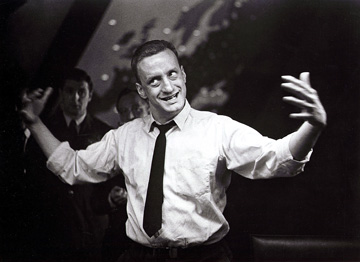
52 Perfect Movies: Dr. Strangelove (1964)

"Gentlemen, you can't fight in here--this is the war room!"

It is rare to find a director with as awe-inspiring a body of work as Stanley Kubrick. Certainly, part of his highly successful "batting average" is due to the relatively small number of films he made--but much more so, it's due to his sheer genius, and the rare manner in which he voraciously and uncompromisingly brought his visions to life on the screen. There are a few Kubrick pictures which will be popping up during this series of 52 Perfect Movies--the first of them is his sublime political and social satire, Dr. Strangelove.

Kubrick would become known as a film-maker of gravity and intense seriousness, and yet here we have him delving into comedy, albeit comedy as black as coal, much like his previous effort of two years earlier, an adaptation of Nabakov's Lolita. And so we are left with a comedy as only the mind of Kubrick could've given us, wickedly funny, yet unrelentingly bleak; a "message film" concerned deeply with the fate of the world itself, yet also with the foibles of human nature, that manages to remain the complete opposite of preachy or self-righteous.

There really is no other film like Dr. Strangelove. Impossible to completely categorize, it is at times an all-out comedy--or more appropriately, a satire--which for much of the picture, doesn't "feel" like a comedy. With the exception of the appearance of the good doctor himself at the end--an example of Peter Sellers' brilliant physical comedy--much of the humor is slyly cloaked, and can even partly go over the head of some, shall we say, less astute filmgoers.

There's also the fact that it doesn't look like a comedy. Like most of Kubrick's work, it's heavy and ponderous looking, shot with stark shadows and sterile, almost dehumanizing production design. No one since Orson Welles knew how to use a camera as brilliantly to his advantage as Kubrick did, although in this particular case much of the credit goes to cinematographer Gilbert Taylor, the Englishman who would later work on such masterfully shot films as A Hard Day's Night, Repulsion, The Omen, and a little 1977 popcorn flick known as Star Wars.

In a lot of ways, Dr. Strangelove shows Kubrick really coming into what would be perceived as his "later" phase, in which his films are concerned with nothing so much as the alienation of the human soul, and the slow-burning anxiety of a seemingly perfectly balanced situation sent hopelessly and inevitably off-kilter. This was during the heart of the Cold War, when, despite how things turned out, many did earnestly believe that the world lay constantly on the brink of annihilation, and perhaps this was so. There's a real concern with this matter in Dr. Strangelove, underneath all that ludicrousness. As wry as the presentation is, and as bone dry the comedy is, the heart of this picture is quite serious.

Kubrick's flair for unforgettable imagery and jarring juxtaposition is here in full force. The sexualized mid-air refueling scene that opens the film, accompanied by romantic strings. The maniacal visage of Sterling Haydn's Gen. Jack Ripper, phallic cigar clenched in his teeth. Slim Pickens' iconic ride on the nuclear warhead. The closing moments of atomic Armageddon, set sardonically to the strains of the traditional wartime anthem "We'll Meet Again" by Vera Lynn. No one will ever meet again, because the world is coming to an end--that closing tune mocks the manner in which the Western world clung to outdated concepts of warfare in a time when those rules no longer applied.

And yet just as much as Dr. Strangelove is a triumph from a technical point of view, it is one of those films that is also just as much of a triumph thanks to the stellar performances of its lead actors. George C. Scott is a revelation as the war-mongering Gen. Buck Turgidson (one of the greatest character names in movie history), a role that put the gruff actor's abilities to exquisite use. Haydn takes us to the depths of madness while at the same time never undermining the ridiculousness of the proceedings, painting the portrait of a deranged, potentially genocidal lunatic who would wipe out civilization to quell the paranoia and doubt raised by his impotence as a man and as a leader.

Then of course, we have Peter Sellers. One of the greatest comic geniuses of the 20th century in what may be, when all is said and done, the most impressive cinematic turn of his career. He was rightfully nominated for an Oscar for playing three different roles, giving him the interesting distinction of being the only actor so nominated for a movie in which he played more than one character.

As Group Capt. Lionel Mandrake, Sellers sends up British propriety and comments on the strained behind-the-scenes alliance of the U.S. and the U.K. in the face of a common enemy. As President Merkin Muffley, he is the epitome of the stifled, emotionally deadened American, a man whose ineptitude becomes both situation comedy and horrifying cultural commentary. And finally, as Strangelove himself, Sellers unabashedly displays his comedy chops as a crippled ex-Nazi desperately fighting to suppress his sheer ecstasy as the world collapses into chaos.

Any one of these parts would have made him the highlight of the picture. With all three, the movie is utterly and wholly his, and it's easy to see why he was a Kubrick favorite. It doesn't make sense somehow that Kubrick and Sellers would be such a perfect match, but it's undeniable that they were.

The razor sharp wit of Dr. Strangelove is rooted in a specific time and place in American history, and yet it's still paradoxically timeless as well. There are moments that resonate just as profoundly as they did 45 years ago, such as Turgidson's outrageous and often-mimicked tirade in the war room, Ripper's deluded rant to a terrified and helpless Mandrake about "precious bodily fluids", or Merkin's panicked, creepily childish yet at the same hilarious phone call to the Soviet premier.

Dr. Strangelove is a bold statement that cinema was changing and that the things film-makers could say--and the ways in which they could say them--was changing as well. To watch it is to watch a true visionary coming into his own, and proving that sometimes there actually can be something new under the sun. There are few experiences for a moviegoer as unique as this film, a complex, dark and endlessly amusing statement on the insanity of the world and its inhabitants that seems to tell us, "If you can't laugh at all of it, what else can you do?"

NEXT UP: The Good, the Bad and the Ugly (1967)

Tuesday, July 13, 2010

The Great Unwatched: Bava, Argento, Cronenberg

There are two goals to my Great Unwatched project. The first is to see some films that I might not otherwise give the time of day to. The second is to finally experience movies I should've watched a long, long time ago. This weekend, I focused especially on the latter goal, filling in gaps in the filmographies of three of my favorite horror directors: Mario Bava, Dario Argento, and David Cronenberg. I even made a special effort to watch some of their non-horror offerings mixed in with the usual fright flicks.

Film 1: Hercules in the Haunted World (1961, Mario Bava)
Bava's second (credited) turn as director is a fascinating tale of swords 'n' sandals with a bit of Christopher Lee thrown into the mix. Hercules (Reg Park) journeys to Hades to retrieve a mystical stone that will save the life of his lady love, Princess Deianira. What our musclebound hero doesn't know is that his girlfriend's wicked uncle (Lee) is machinating to use Deianira's blood in a ritual to make him immortal. Hercules in the Haunted World was Bava's first opportunity to show what he could do with color and he really wows. The scenes of hell in particular show his visual mastery. Reportedly Bava used a few movable walls and a handful of columns to form every interior set in this film, resorting to visual trickery when he needed it to look like he had more. He creates an expressionistic peplum film, which works best when taken as a visual feast hung on a loose plot.


Film 2: Erik the Conqueror (1961, Mario Bava) 
An unofficial remake of Richard Fleischer's The Vikings (1958), Erik the Conqueror (also known as The Invaders) tells the tale of two Viking brothers, separated as children when their village on the coast of England is pillaged by the vicious Sir Rutford (Andrea Checci). Eron (Cameron Mitchell) is raised by his Nordic brethren. Erik (George Ardisson) is adopted by the Queen Alice of Scotland (or Britain, depending on whether you're watching the movie dubbed or subtitled) and grows up to become the Duke of Helford.


What struck me about Erik the Conqueror was the care taken that neither Viking or English were portrayed as villainous or unsympathetic. Both sides are caught in the cycle of violence known as history, occasionally manipulated by Sir Rutford to achieve his own ends. Certainly the Vikings are portrayed as more brutish and violently-inclined, but they're also largely honorable, honest people. The English are more cultured, but they are given to subterfuge and, in the case of Sir Rutford, outright treachery. 

The best sequences, visually, take place in the Viking's headquarters, a large cave where Bava's colored gels run wild. The centerpiece of the set is the giant gnarled tree from Hercules in the Haunted World, which looks magnificent in this new context.

Overall, however, the film isn't that interesting, unless you're really into vikings.

Film 3: Fast Company (1979, David Cronenberg)
It's certainly possible to read a lot of Cronenberg's prevalent themes into Fast Company, most notably the intersection of man and technology and the betrayals of corporate America. However, I think it misses the point to a certain extent. This is Cronenberg working in established drive-in fodder territory for the first and only time in his career. He sticks pretty cleanly to the rules by providing a story with clear heroes and villains, plus the requisite amounts of sex and action. William Smith plays Lonnie "Lucky Man" Johnson, a race car driver in his twilight, doing the drag race circuit under the sponsorship of FastCo Oil. When FastCo betrays him (through their corporate liaison Phil Adamson, played by John Saxon), he strikes out on his own. Adamson uses every trick in his book to make sure Lonnie's cars never reach the finish line. Fast Company is slow-moving (ironically) and takes forever to get around to its central conflict. Cronenberg really only breaks out of the mold during a surprisingly brutal climax that kills off two characters and seriously injures a third.

Film 4: Inferno (1980, Dario Argento)
I still don't know what I feel about this one. Certainly it's the most beautiful Argento film I've ever seen. However, the plot is a huge wad of happenstance, with very little rhyme or reason. In some places it seems to want to emulate the structure of its predecessor, Suspiria, but it lacks a character like Susie Banyon for us to relate to. I'll admit that I was already starting to get a little burned out at this point in my marathon, so I might not have given Inferno the due it deserves. Next time I watch, I'll do it properly -- well-rested, with all the lights out, and the soundtrack up loud. Until then, I can't really give a strong opinion one way or the other.

As a bonus to my general theme, however, Mario Bava did some uncredited effects work for the New York segments of the film.

Film 5: Rabid (1977, David Cronenberg)
Rabid is much more in line with Cronenberg's general oeuvre. Marilyn Chambers emerges from experimental surgery with a retractable phallus in her armpit and a craving for blood. Those who she feeds from become blood-crazed zombies. Cronenberg expands on the themes he first posited in Shivers, with disease as a catalyst for societal breakdown. Moving outside the confines of a single apartment building into the city of Montreal, Cronenberg is able to analyze government and public responses to an outbreak of irrationality. Meanwhile, on a parallel track, Chambers is just trying to survive, oblivious to the effect her feeding has on her victims (and her victims' victims). Unfortunately, Cronenberg never manages to blend the external outbreak narrative with the internal vampire one, so the film gets narratively and thematically confused at times. Cronenberg would do better in later films by keeping his focus on a single character navigating through the chaos, as in Videodrome.

Film 6: Phenomena (1985, Dario Argento)
Not a lot to say about this one, except that it was the last film of the night and it didn't do much to grab hold of my already shaky attention. As a sidenote, at some point I may write an article tracking Argento's treatment of Daria Nicolodi's characters throughout their collaborations, as it does seem he gets more brutal with her after they broke off their romantic relationship.

My original plan, incidentally, had been to watch Four Flies on Grey Velvet, but my bootleg (purchased before Mya Communication announced their official DVD) was nearly unwatchable. Very disappointing.

52 Perfect Movies: Psycho (1960)

"We all go a little mad sometimes..."

Where does one begin in talking about Alfred Hitchcock's Psycho, one of those watershed motion pictures that can literally be said to have helped change the course of the development of movies as we know them? Here is a film that has been studied, analyzed and digested over the course of decades of scholarly attention and fan obsession, and anything I say to praise its greatness has doubtless already been said many a time. But truly, if there are any titles that a series called "52 Perfect Movies" immediately conjures up, Psycho has to be on the short list. The perfect blending of commerce and art, it represents the greatest heights to which popular entertainment can aspire.

At the time Psycho was made, the Hollywood film industry was at something of a crossroads. The "golden age" of the silver screen was coming to a close. Studios were rapidly losing their power, and the directors (and to a certain degree, the actors), were gaining more creative control. The often draconian hold of the censorious Hays Production Code limiting what film-makers could put on screen, was starting to lose its grip--a process that would continue over the course of the 1960s. It was the perfect time for a film like Psycho to come along.

Psycho wasn't the first of what we'd call "modern thrillers", having been preceded by pictures such as the French triumph Les Diaboliques, but what it did was popularize the concept amongst mainstream American audiences. It was something of a departure for Hitchcock, who, since coming to Hollywood, had become known for sumptuous, full-color "event movies". This time out, he went back to basics, stripping everything down to the bare bones, for a lean, mean, suspense machine of a movie that never stops being endlessly fascinating and never fails to work on every single level, a half century after the initial shock of its famous surprise ending has worn off.

This is the kind of film that the word "timeless" was meant to describe. Literally from the opening shot, we are drawn into this ominous, brooding, somewhat seamy world of adultery, larceny, intrigue and God knows what else. Janet Leigh is perfect as the sultry, flawed and yet charismatic Marion Crane, a main character we come to identify with only to witness brutally murdered not yet halfway into the picture--surely one of the boldest narrative maneuvers ever attempted in American cinema up to that point in time.

Her murderer, although we do not know it at that time, is the deranged Norman Bates, played with boyish charm and naivete by a young Anthony Perkins, whose performance was inexplicably denied the Oscar nomination with which Leigh's was recognized. Nevertheless, he is note-perfect as the stammering, seemingly harmless Bates, caught in the ultimate Oedipal struggle with his off-screen "mother"--it's easy to see how 1960 audiences would've been totally caught off guard upon discovering the true nature of that relationship.

And speaking of that, Psycho was particularly groundbreaking in its relatively frank approach to sexually charged subject matter. Remember, this was still a relatively culturally conservative time in American pop culture (to give you an idea, Psycho is the first American film to depict a flushing toilet bowl), and so Norman's cross-dressing, not to mention Marion's nudity during the shower scene, was pretty heady stuff.

It's that shower scene, naturally, that everyone still talks about to this day when discussing this unquestioned classic. A masterpiece of editing, sound design and photography, many have called it the finest scene ever put to celluloid, and it's tough to argue that. One of the most amazing things about it is that anyone who sees it, especially for the first time, will swear they saw way more skin and blood than they actually did--they may even claim to have seen the knife penetrate Marion's flesh, which we never do. That's powerful film-making.

That scene, and so many others in Psycho, would have lost so much of its impact were it not for what may be the most famous film score of all time, composed by Hitchcock veteran Bernard Herrmann. In an era of sweeping studio orchestral pieces, Herrmann chose to go with a small, all-strings ensemble, a relatively unheard of approach that would later become much more popular thanks to its success in Psycho. Not only the unforgettable staccato sounds of the shower scene cue, but every single cue in the film is burned into the consciousness of film lovers the world over. For my money, only the work of Sergio Leone rivals it in terms of combining such high levels of both originality and pure skill.

Films would be different after Psycho, particularly those films meant to scare, upset or disturb us. No longer would monsters and other supernatural things that go bump in the night be the primary tools of those purveyors of cinematic terror. Rather, Hitchcock proved in his brilliant adaptation of Robert Bloch's novel, that the most fearsome monster of all is the human mind itself, and it could be the one residing in the person living right next door to us. This became the message of modern horror: The monsters are us.

Hitchcock was known for his uncompromising perfectionism, and perhaps nowhere does it come across so powerfully as in Psycho. Making the most of a streamlined production crew assembled from the staff of his TV show, Hitch's fingerprints are on every single one of the great John L. Russell's breathtaking shots, in the almost palpable lighting that reminds us over and over again why this film had to be made in black and white, despite the industry's transitioning to color at the time. Nearly every line of Joseph Stefano's script has become an iconic quote, not just those given to Perkins and Leigh but also to outstanding supporting players like Martin Balsam as the hard-boiled Det. Arbogast, and Vera Miles as Marion's bereaved sister Lila.

Perhaps the finest intersection of art film and pop culture, Psycho has truly stood the test of time, and remains that one movie that film students most relish digging into. This is not some moldy "classic" forced upon younger generations by preachy academics--this is a living, breathing masterpiece, and a joy to experience over and over again.

For more, please check out The Vault of Horror's ongoing series, "Psycho Semi-Centennial"!

NEXT UP: Dr. Strangelove (1964)

Tuesday, March 2, 2010

The Great Unwatched: Legend of the 7 Golden Lawrence of Arabias


I think we can all agree that Legend of the 7 Golden Lawrence of Arabias (American title: 7 Arabs vs. Dracula) would be an awesome movie. And Legends of 7 Golden Vampires and Lawrence of Arabia aren't that dissimilar when you come down to it. A white guy in an epic war helps a foreign people figure out how to combat their common enemy, believing he's doing it without impinging his own Western values upon their culture, but totally doing it anyway. In the end, our white hero is caught up in the violence and the whole matter ends an ambiguous note -- the battle won, but the cost far too great.

Of course, one is a 90-minute kung-fu vampire movie and the other is a 3.5 hour David Lean epic about the Arabian involvement in World War I. But otherwise, you know, same film.

Moving on.

There's a theory of film criticism (the name of which escapes me at the moment) that suggests that the written word is insufficient for interpreting film, because it is not, itself, an audiovisual medium. I am not riding that train of thought (obviously, since I can't even remember what it's called), but when I watch a film like Lawrence of Arabia, I can sort of see the point.

I could tell you about the amazing compositions, the way that Lean uses empty space to evoke a true feeling of grandeur. I could discuss the complex political implications and the fact that its protagonist is allowed to go an entire film being very wrong about a number of things and the film ends with him being very wrong about a number of different things.

This is not one of my favorite films ever and yet I am humbled by the task of discussing it. So I won't. Within the next year, however, I will, I promise.

But it might not be in writing...

Thursday, January 28, 2010

The Great Unwatched: The Deadly Bees (1967) and Out of the Past (1947)


Out of the Past (1947)

Director: Jacques Tourneur
Runtime: 97 minutes

As the credits came up on Out of the Past, I thought to myself, "I have never seen a film-noir before this; I only thought that I had." This thought is particularly amusing, because as Tourneur's movie opened -- and despite the title card -- I thought that I'd put the wrong disc in the player.

Let me explain. Out of the Past has a reputation as one of the great film-noirs, a genre known for their oppressive cityscapes and chiaroscuro lighting. Tourneur's past work with Val Lewton's horror unit demonstrates that he has a way with shadowy cinematography. So it's a shock when the first sights we see in Out of the Past are open plains, the first sounds a slightly rustic musical cue. One of the credits notes that the film is based on a novel called "Build My Gallows High." When we finally see a hard-top car driving along the country road, it's a relief -- this is not a Western after all.

Of course, this is the genius of Out of the Past. It's a film that seems to define the film-noir experience, but it wouldn't work without the film-noir tropes already established by earlier films. One of the key elements of great film-noir is that those elongated shadows and endlessly criss-crossing city streets form a prison around the protagonist, locking them into the date with destiny they made when they gave in to their passion. Opening on a sun-bathed rural community is a calculated surprise; it drives the mystery before a single word is spoken. Why are we here and not the city? What is coming out of the past? The Western associations also work in Tourneur's favor. That car that drives up the road is both welcome (because it's a clue we're in the movie we expected to be) and strange (its dark color makes it look like an unwelcome invader of this dusty village).

The man in the car is looking for Jeff Bailey (Robert Mitchum), the local gas station owner who used to be another person entirely -- Jeff Markham, private eye. Their meeting begins Out of the Past's descent into darkness, as night and shadow creep into the tale (both metaphorically and visually) with alarming speed. Markham became Bailey to hide from a big-shot named Whit Sterling (Kirk Douglas). Why he went into hiding is a story he tells his girl during the drive to Sterling's lodge, with the requisite flashback and narration. Why he needed to hide comprises the rest of the movie.

My original summary of the film isn't accurate; it's not that I hadn't seen a film-noir before, it's that I'd never seen a film-noir protagonist before. How could there be any other except Robert Mitchum? The rest, even his predecessors, seem like pale imitations, shadows if you will. Hard-bitten doesn't begin to describe him. When he breathes, "Baby, I don't care" to Jane Greer, you know that he goddamn means it. He has a way with conveying emotion that's guarded and revealing all at once. When his deaf station assistant tells him he has a visitor, his face barely moves, but his expression changes all the same. It's a masterpiece of performance.

Worth the Purchase? Oh definitely.


The Deadly Bees (1967)

Director: Freddie Francis
Runtime: 83 minutes

This one's a bit of a cheat, as I'd seen a truncated version of The Deadly Bees once in an episode of Mystery Science Theater 3000. A lack of wisecracking robots does this film no favors, unfortunately. It's slow, repetitive, and silly. A pop star (Suzanna Leigh) goes to a remote island to recuperate from a nervous breakdown, only to be caught in a hive of villainy -- one of the island's two beekeepers is releasing a new strain of killer bees on the unsuspecting populace. Is it cold, forceful Guy Doleman or the doddering, avuncular Frank Finlay? Does the audience care? Notable mainly for a strong performance from that ubiquitous supporting player of British horror, Michael Ripper, as the local barkeeper/lawman.

Worth the Purchase? I should've been stingier with my money.

--

In Two Weeks: Legend of the 7 Golden Vampires (1974) and Lawrence of Arabia (1962)

Sunday, March 15, 2009

The Great Unwatched: Help! (1965)

Director: Richard Lester

Runtime: 90 minutes

I can safely blame Tim Lucas for this one. About six months ago, he pointed out a fire sale that Amazon.com was having on the deluxe box set of Help! -- something like an 80% savings. Not bad, especially considering that the box (which usually goes for $120) contains a reproduction of Richard Lester's annotated (read: scribbled on) shooting script, a hardbound commemorative book with production notes and exclusive photographs, a poster, and eight lobby cards. Oh yeah, and the movie and its special features disc. Those are kind of important. The same deal is going on, actually, to a slightly lesser degree -- just check Amazon's sellers page for the outfit "warehouse_deals." I can report that my own set arrived without any of the issues in their description.

As for the film itself, I can safely agree with many other critics who have pointed out that it's silly nonsense. I can agree even more with fans of the film that find the silly nonsense to be, at least, inspired nonsense. Richard Lester is a director I have a lot of respect for and his work with The Beatles in this and A Hard Day's Night shows a man who completely grasps the pop mystique of the Fab Four. Just look at the differences between AHDN and Help!, films made within a year of each other, which can be a whole era in the life of a pop band.

A Hard Day's Night had the boys chased around like mad, with screaming fans around every corner. Now, a year later, they've settled in; they're far more likely to have busybody housewives discuss them from afar than to be mobbed. AHDN is plotless -- a madcap day in the life of the most popular band in the world, before anybody's quite figured out what to do with these four moptopped lads from Liverpool. In Help!, a plot (although admittedly not much of one) asserts itself, and the boys have to play keepaway with a special sacrificial ring that's become stuck to Ringo's finger. Now there's structure, a way to align the band with standard conventions, even if they have a tendency to play fast and loose with said conventions. Actually, the elements of the plot actually reverse the first point of the paragraph -- The Beatles are still getting mobbed in Help!, but now it's from people who want something from them and/or who are against their music and what they stand for (the opening credits involve a religious cult throwing darts at a film of the band performing the title song). Still, there's nothing quite so sublime in Help! as the "Can we have our ball back?" bit from AHDN (which I've helpfully embedded below).


Comparisons aside, though, it's clear that everyone involved is having a lot of fun. Richard Lester maintains enough control on the shenanigans that they do not become tedious, but not so much control that he takes the fun out. He leaves in plenty of room to riff on things like the James Bond series, British labor unions, and even basic cinematic conventions like intertitles (there are many, many intertitles in this film and nearly all of them funnier than they have any right to be). If there's a major complaint here, it's that we don't get a strong notion of each band member's individual style and personality. Oh, it comes through in pieces here and there, but at points they seem more like a hive mind of jocularity than four independent minds.

I really dug this film a lot, so I should probably thank Tim Lucas instead of assigning blame. Except blame is more fun.

Worth the Purchase: If you don't know my answer, then Ringo isn't the only one who needs help.

Now, if you'll excuse me, I've just started Scott Allen Nolan's book on Boris Karloff and I'm looking forward to a fascinating read.

Stats: 23/401 movies watched in nineteen days.
Currently Projected Completion Date: January 21, 2010
Completion Date Goal: February 25, 2010